Showing posts with label growing power. Show all posts

07 May 2010

Growing Power Graduation


I can't wait for next week to get here. Why? It is the graduation of the 5 month course in Commercial Urban Agriculture given by Will Allen's Growing Power (http://www.growingpower.org/) in Milwaukee. It started in January the day after a blizzard dropped 16 inches of snow and the temperature hovered around 10 degrees. I walked into an almost tropical Growing Power 'hoop house' heated solely by 4 compost piles in the corners and more around the sides. I felt I had walked into the Garden of Eden! Lush green plants hanging every where, the gurgling of water through fish tanks and the rich deep smell of black soil, that I later learned by produced by Will and his worms from the mountains of compost at the site. And I do mean mountains - upto 20 feet high!


Over these 5 months we have learned all about composting, vermiculture, mushrooms, aqua-ponics, laying in raised beds, hoop house construction, bee keeping, marketing and back to composting, composting, composting. This has been the most highly structured unstructured educational program I have ever encountered. Will and his staff are completley knowledgable on every subject, enthusiastic and definitely hands-on. They are constantly busy, doing what has to been done to care for the plants, to take care of the custumer accounts, and the animals on the urban farm site in the middle of Milwaukee. Will Allen has written and spoken extensively about the food crisis in this country, but most importantly, he has acted - acted in a consistent way for a long enough time that he is now getting the recognition that he so richly deserves. He has recently been featured in Jet Magazine and selected as one of America's Most Influential People by Time Magazine. But the attention is not to feed his ego, but rather to feed hungry people who are trying to survive in the middle of all these 'food deserts' as Will calls the urban blight areas across the country where there is no real food for people to eat. How can they keep healthy like that, work and be productive, how can they have creative minds and do well academically?


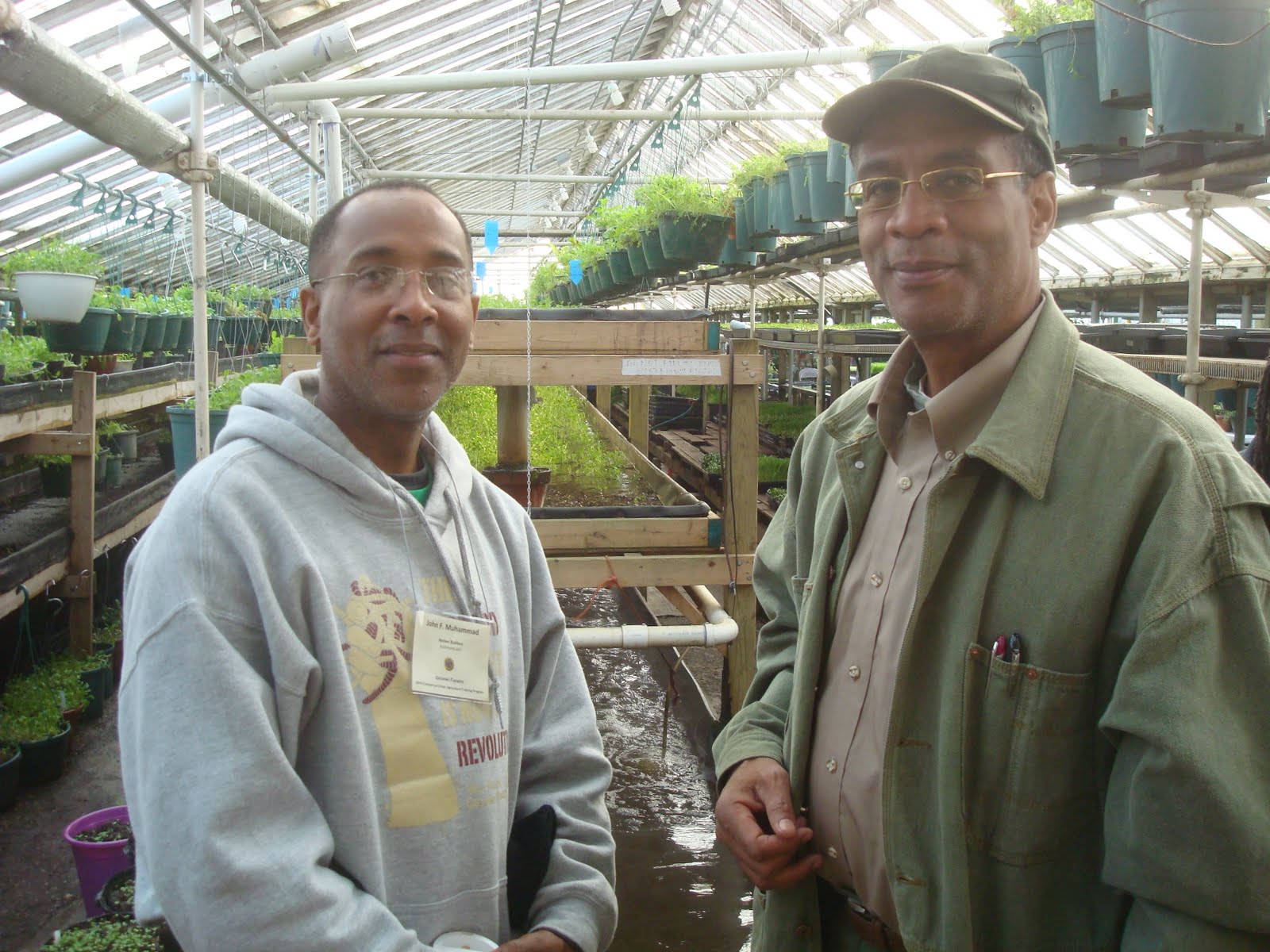
So as Bro John Muhammad and I prepare for our graduation, we know that this is just the beginning of the "Food Revolution". My personal goal: 100 hoop houses built all over the country in the next 2 years! Is that achievable? You bet, especially if you help. You should get involved now. Learn all about hoop house agriculture. Build a hoop house and start growing your own food. Find out all about it by clicking on the Growing Power web site. Get started now.


05 May 2010

Will Allen Makes Time 100 Influential List

Here is Will Allen of Growing Power atop a mountain of compost which is the basis for his hoop house system of growing food in the middle of urban 'food deserts' where good food is impossible to find. Urban Agriculture as modeled by Growing Power can make the food deserts bloom, providing low cost nutritious food and jobs and economic opportunities all across America. Congratulations Will!
Will Allen on Time 100 Most Influential List - Pick
Milwaukee(April 29, 2010) – Will Allen, the founder and CEO of Growing Power Inc., has been named to the 2010 “Time 100: The World’s Most Influential People.” The list was released on Thursday, April 29, and the magazine will hit newsstands last Friday April 30th.
The much-anticipated announcement identifies 25 individuals or small working groups who are most influencing the current course of world events in four categories: Leaders, Heroes, Artists and Thinkers. Allen was named in the area of Heroes.
Allen was identified for his powerful advocacy for food security and food justice for all. Through his work promoting urban agriculture, Allen has called attention to the widespread existence of “food deserts” in cities across America, where whole communities lack access to fresh, nutritious and affordable foods.
The solutions Allen has proposed and argued for in the 18 years since his founding of Growing Power, a non-profit urban farm and training center in Milwaukee, include a return to localized food systems and teaching communities where good food is unaffordable to grow it themselves.
“We have seen the results of our reliance on the industrialized, commoditized food system we have built since the middle of the last century: A rapidly rising rate of obesity in generation after generation, leading to alarming rates of diabetes and heart disease, so that for the first time in America, despite all our advances in medicine, our life expectancy is falling,” Allen said.
“Finally, we are learning that treating illness is much less effective than preventing illness by promoting health; and that good food is the best and most fundamental preventive medicine of all.
“Polls now show that 86 percent of Americans want good food, real food; fresh, locally grown food that is safe and free of chemicals and genetic modifications. But there is simply not enough good food being grown for all those who want and need it. I am simply trying to help change that.”
Driving home the point that the Good Food Revolution, as Allen has declared it, is no longer a fad but a fact, Time also named author and food advocate Michael Pollan (“The Omnivore’s Dilemma”) to its list, as well as others such as Valentin Abe, who has successfully introduced tilapia farming to a depleted lake in Haiti.
Time magazine created its first 100 list in 1999, when it named the most influential people of the 20th Century. In 2004, the magazine started the annual list, stressing that the people it names are not necessarily the most public, popular or powerful, but often are the most innovative or inspirational and the most apt to effect change.

26 April 2010

Corporations Pressure Congress to Make Real Food Illegal

Having just returned from Growing Power in Milwaukee where I am taking a 5 month course in Commercial Urban Agriculture, it is shocking to the system to read the following article which indicates that Congress may be taking away one of the most basic of human rights - the right to have good food. The big corporations are trying to outlaw what they can never provide - good food, real food that is produced locally. All they can offer is fake food products that do not nourish and which are not sustainable. So the battle lines are drawn: people vs the corporations. Let's get ready to rumble! Our very survival is at stake.

Enjoy. Learn. Share.


Goodbye farmers markets, CSAs, and roadside stands

By Linn Cohen-Cole

The "food safety" bills in Congress were written by Monsanto, Cargill, Tysons, ADM, etc. All are associated with the opposite of food safety. What is this all about then?


In the simplest terms, organic food and a rebirth of farming were winning. Not in absolute numbers but in a deep and growing shift by the public toward understanding the connection between their food and their health, between good food and true social pleasures, between their own involvement in food and the improvement in their lives in general, between local food and a burgeoning local economy.

Slow Food was right - limit your food to what comes from your region and from real farmers, and slow down to cook it and linger over it with friends and family, and the world begins to change for the better.

And as we face an unprecedented economic crisis, and it is hard to be sure what has value, one thing that always does is food. Which is why the corporations are after absolute control over it. But what obstacles to a complete lock on food do they face? All the people in this country who are "banking" on organic farming and urban gardens and most of all, everyone's deepening pleasure in and increasing involvement with everything about food.

Farmers markets. Local farmers. Real milk. Fresh eggs. Vegetable stands.

Those are things we not only all want, but things we are actively getting involved in, and things we very much need. And where they are truly good, they are growing.

The international financial corporations which have wreaked havoc around the world with astounding nonsensical "solutions" that are destructive of everyone but them, are brothers to the international agribusiness giants (Monsanto, Cargill, Tysons, ADM, etc.) which are just as aggressively after their own form of "taking." Just seeds, animals, water, land.

And freedom.

Because human beings are by in large good and by in large incredibly resilient and clever, and left to their own devices - that is, free - they would handle this gargantuan financial stupidity the corporations brought us with NAFTA, CAFTA, GATT and all other globalized schemes (which they hope to eventually top off with CODEX). How? By being productive in real ways and locally. And farming is the solid ground under that. Farmers produce something of real value (something we used to take for granted), and from that base, businesses grow up. Local markets, local food processors, local seed companies, local tool and supply companies, local stores ... and an economy based on reality and something truly good for us, too, begins to grow.

So, look again at what has been exciting us - Farmers markets. Local farmers. Real milk. Fresh eggs. Vegetable stands. - and realize that they are not only wonderfully healthy but fun and naturally community building. And more, they are a real economy and deeply democratic - and just at a time we need something that works economically, that supports our democratic rebirth, and that protects food itself and our easy access to it.

And it is all those things that threaten the corporations ... which is why we now have these massive "fake food safety" bills in Congress. Everything is going under thanks to these fools, and they wish to be there like vultures to make sure that every drop of blood that can be sucked out of our resources and us, is theirs. To wit, they must get rid of such good and innocent things and yet truly powerful things as:

Farmers markets. Local farmers. Real milk. Fresh eggs. Vegetable stands.

And how will those who contaminate our country's food with pesticides, hormones, antibiotics and more, do that? Why, by setting standards for "food safety" that are so grotesquely and inappropriately and even cruelly applied to a local, independent farmers and ranchers that there is no way they can manage. Imagine your being faced with a 100 page IRS form and facing a million dollar a day penalty for screwing up. That would be in the ball park of the impossible complexity mixed with threat facing our farmers. Imagine having the government and corporations deciding every single thing you can do and must do in your kitchen and backing that up with the threat of 10 years in prison for screwing up - though you have never made anyone sick, and those corporations have. Imagine being surveilled 24 hours a day by GPS tracking devices that feed into ... a corporate data bank, one they have now moved out of the country so no one here can have legal access to see what is in it.

Imagine the devil himself - or a whole boardrooms of them, dressed in suits - defining the only safe and healthy food in this country as dangerous and burdening hard working farmers with more work then anyone could bear, while his own, their own, food is so dangerous at this point that in the last 10 years alone, diabetes has gone up 90%.

And how did they get this far with such a scheme to apply insane industrial standards to every farm in the country? Through fear of diseases and of outbreaks of food borne illnesses, both of which they cause themselves.

How it works: Tyson helps Bill Clinton get into office. Bill Clinton immediately and significantly lowers contamination standards for poultry as a thank you. And it is such contaminated waste from transnational poultry factories which is now implicated as the source of bird flu. Then fortunes on made on that fear. And then poultry industry uses the crisis they created to push out small farmers and take greater control than ever. Their mantra? Biodiversity not only be damned but be eliminated. And get rid of those damn farmers who protect it while we're at it.

The bills would require such a burdensome complexity of rules, inspections, licensing, fees, and penalties for each farmer who wishes to sell locally - a fruit stand, at a farmers market - no one could manage it. And THAT is the point. The whole dirty tricks point. The whole "be in tight control of everything needed for survival because it'll be worth a fortune" point.

So, if you like farmers markets, local farmers, fresh milk, fresh eggs, vegetables stands, and freedom, let your friends know that it's all on the line right now with those "fake food safety" bills brought to us with well-planned evil and more of it to come, by Monsanto, Cargill, Tysons, ADM, etc.

Slow Food reminds us of just where we need to be (and notice how much would help any local economy):

  • Forming and sustaining seed banks to preserve heirloom varieties in cooperation with local food systems;
  • Developing an "Ark of Taste" for each ecoregion, where local culinary traditions and foods are celebrated;
  • Preserving and promoting local and traditional food products, along with their lore and preparation;
  • Organizing small-scale processing (including facilities for slaughtering and short run products);
  • Organizing celebrations of local cuisine within regions (for example, the Feast of Fields held in some cities in Canada);
  • Promoting "taste education;"
  • Educating consumers about the risks of fast food;
  • Educating citizens about the drawbacks of commercial agribusiness and factory farms;
  • Educating citizens about the risks of monoculture and reliance on too few genomes or varieties;
  • Developing various political programs to preserve family farms;
  • Lobbying for the inclusion of organic farming concerns within agricultural policy;
  • Lobbying against government funding of genetic engineering;
  • Lobbying against the use of pesticides;
  • Teaching gardening skills to students and prisoners; and
  • Encouraging ethical buying in local marketplaces.

  • But we need to stop these bills first or we are left with no money from the financial bailout and no food from the food stealout.


    We need millions to be fighting this. Contact Eli Pariser at MoveOn moveon-help@list.moveon.org to tell him MoveOn is badly needed.

    And below, where Oped News offers a means of writing your local newspaper, take advantage of a chance to vent.


    Author's Bio: Met libertarian and conservative farmers and learned an incredible amount about farming and nature and science, as well as about government violations against them and against us all. The other side of the fence is nothing like what we've been taught to assume but great people with immense decency.

    04 April 2010

    We Built A Hoop House In Baltimore!


    Brother John Muhammad of Baltimore and I have been going up to Growing Power in Milwaukee for the past 3 months to learn Commercial Urban Agriculture from Will Allen and his staff. We have been excited about the possibilities that urban gardening offers to people all over the country - in fact all over the world. Will Allen's concept of urban farming begins and ends with the soil, but the growing of plants year round is made possible by 'hoop houses'. A hoop house is a low cost greenhouse, that self-heats in the winter time allowing plants to grow safely inside no matter how cold it is outside. Properly managed hoop houses can supply unlimited amounts of food for urban families and communities that are often the worst fed segment of society. Urban hoop houses can fill the nutrition gap and offer a commercially viable business opportunity to many who right now are unemployed or under-employed in dead end jobs. In one sense, a hoop house is a survival kit that never ends. Every family, every neighborhood, every mosque, every church, every school should have a hoop house to grow their own food 12 months a year! This is the ultimate in the 'eat local' movement. It can make lots of money too.

    So here's the big news -
    ON APRIL 3, 2010 WE BUILT A HOOP HOUSE
    WITH THE HELP OF 15 OR 20 INDIVIDUALS IN BALTIMORE!
    We are on our way. We have left the theoretical and are taking care of practical real world business -moving toward food production and self-sufficiency.
    Here are some photos of the day. Video footage will soon be available too.

    My personal goal? 100 hoop houses constructed in the next year to 2 years.
    Enjoy. Learn. Share.

    06 February 2010

    Making a Living Soil

    So here's the follow up. Since we hear that all the soil is depleted, making the food depleted, then what do we do? We make soil, that's what. That's how we continue to make ourselves a 'living soul' by making a 'living soil'. Get it? You ARE what you eat (and what you eat is of the soil). Got it? Here is a little video that goes into one of the key components of making rich beautiful black fertile soil that can grow anything we need in our Garden.
    Will Allen's most important and valuable livestock, the worms!
    They are the secret and you have to know about it in order to be able to survive. Enjoy. Learn. Share.

    05 February 2010

    It's the Soil, Stupid

    If Man is formed of the dust of the Earth as the Bible and the Qur'an say, then soil or humus is needed to support human life. Without soil human life vanishes. It is my view that one of the great judgements of America that signaled an end to her ability to rule over the nations was the lost productivity in food as a result of the Great Dust Bowl of the 1930's. During those years the rich top-soil of America was blown away and she lost her ability to produce good nutrition for her population. That brought on the age of chemical based agriculture to make up the difference in soil capacity. Only thing is - Man was not formed of the 'chemicals' of the Earth. It's the soil, stupid. With no soil there can be no real food. With no food the power of government to rule vanishes. That makes the science of soil making the most vital science of all for those who wish to survive. That's Growing Power's Will Allen atop a compost heap (above) and (below) Will with his favorite 'livestock' - red wriggler worms!
    Enjoy. Learn. Share.
    Britain facing food crisis as world's soil 'vanishes in 60 years'
    British farming soil could run out within 60 years, leading to a catastrophic food crisis and drastically higher prices for consumers, scientists warn.

    Last year Sydney was blanketed by thousands of tonnes of soil during its worst dust storm in 70 years. Photo: RYAN LAHIFF
    Fertile soil is being lost faster than it can be replenished and will eventually lead to the “topsoil bank” becoming empty, an Australian conference heard.
    Chronic soil mismanagement and over farming causing erosion, climate change and increasing populations were to blame for the dramatic global decline in suitable farming soil, scientists said.

    An estimated 75 billion tonnes of soil is lost annually with more than 80 per cent of the world's farming land "moderately or severely eroded", the
    Carbon Farming conference heard.
    A University of Sydney study, presented to the conference, found soil is being lost in China 57 times faster than it can be replaced through natural processes.
    In Europe that figure is 17 times, in America 10 times while five times as much soil is being lost in Australia.
    Soil is also a valuable store of carbon and can release the greenhouse gas if it is ploughed or dug up.
    The conference heard world soil, including European and British soils, could vanish within about 60 years if drastic action was not taken.
    This will lead to a global food crisis, chronic food shortages and higher prices, the conference heard.
    Despite better than average farming practices, European soil might last for 100 years if no further damage occurs worldwide, scientists said.
    In reality, however, increased land pressures aimed at compensating global production losses would likely mean it will run out faster, they added.
    Last September the
    government launched new plans to protect the nation's soil which included farmers being asked to use less fertiliser.
    Britain imports about 40 per cent of all its food it consumes, a figure that has steadily risen over the past few years.
    Almost £32 billion of food was imported into the UK in 2008 up from more than £27.7 billion the year before.
    John Crawford, professor of Sustainable Agriculture at the University of Sydney, who presented the study, said it was unknown how long soil will last.
    “It could be as little as 60 years and that is a scary figure because it is not obvious that we have time to reverse decline and still meet future demands for food,” he said.
    "It is not an exaggeration to say that soil is the most precious resource we have got, and... (we) are not up to the task of securing it for our children never mind our grand children."
    Prof Crawford, the former chair of the UK Biotechnology and Biological Sciences Research Council’s Agri-Food Committee, said restoring soil required several factors.
    These factors include minimum ploughing, improved management and "resting" soil by covering crops which helps replace carbon in soil.
    It can however, take decades to significantly increase the amount of useful carbon in soil, which helps make it fertile.
    While organic farming could be part of the answer, he said there was "no clear evidence that we can feed the current population using organic approaches, never mind meeting demands in time".
    Latest forecasts predict the world's population will grow from 6.8 billion to more than 9 billion by 2050, placing even further pressure on food production and farming.
    The world last year faced a cereal crisis as wheat stocks dropped to a 30-year low after demand for wheat and rice outstripped supply for the past six out of the previous seven years.
    This resulted in grain prices rocketing, which sparked civil unrest in many countries.
    Extreme evidence of how soil is being eroded was seen in September when
    Sydney was blanketed by its worst dust storm in 70 years.

    23 January 2010

    Growing Power Aquaponics System -video

    One thing about it - no matter what - people have to eat. I am sure you agree. Since we have to eat all year round we need a system of food production - that we control - that produces for us all year round regardless of weather or climatic conditions. Will Allen the founder of Growing Power explains his aquaponics system at the recent seminar that Bro John and I attended in Milwaukee. These are things that we can do. These are things we must do. I am sure you agree.
    Do you know of something more important than this?
    If you do let me know what it is.
    Shouldn't you have a hoop house with aquaponics
    beside your house, or in your neighborhood?
    Enjoy. Learn. Share.

    21 January 2010

    The Ultimate Survival Kit

    This past Sunday I had the opportunity to speak at Mosque No. 6 in Baltimore. My subject was a continuation of a new topic for me entitled: "A New Slant on How to Eat to Live - Back to the Garden" (an audio tape is available from the mosque) It was actually in part, a report on the recent visit to Growing Power in Milwaukee founder by Will Allen. Will Allen is launching a 'food revolution'. He is teaching an intensive series of workshops in all aspects of 'commercial urban gardening' the center piece of which is the 'hoop house'. A hoop house allows for year round gardening on a commercial scale. As Will said it, "You like to eat year round, so you have to have a source of food year round too." Makes sense. Hoop house contruction is about a $1500 investment. Once you build your compost and make some soil, you're ready to go.
    Year round food of your choice in abundance makes the hoop house the ultimate survival kit. And when the economy folds up and the dollar crashes, you will have a commodity to barter and trade with. Food will be the new money - at least for a while. Read the following article to get a glimpse at what may soon be upon us. Then stay tuned for more on hoop house urban agriculture that anyone can do.
    Enjoy. Learn. Share.

    How Can Localities Cope if the Dollar Crashes?
    A “run on the dollar,” or any currency, for that matter, takes place when the currency is losing its value. This happens when a country’s debt becomes so great that there is danger of a major default–that is, large scale or even national bankruptcy. At that point, people whose wealth is in that currency, or in relatively liquid assets denominated in the currency, try to get rid of them as fast as they can. Today, that includes foreign countries like China or Russia that are holding large quantities of U.S. government bonds.
    The U.S. currently is at risk. We see it in personal and business bankruptcies and foreclosures. One result can be a high rate of inflation in certain products like food or gasoline, even while asset prices, as with homes and stocks, are going down. The question is now whether the “recovery” that is underway can be sustained or will there be another crash like there was in late 2008 to early 2009.
    Forecasters are projecting this recovery to last until June 2010 but are foreseeing slippage at that point. Investors at this time are still putting money into the stock market and getting out of dollars. By June, the U.S. government had better come up with a strategy for real economic growth–which means jobs–or we will likely see the “double-dip” recession many have predicted. Personally I see no way growth can be sustained unless the national debt burden shrinks. This can only be done through an orderly process of debt forgiveness, a resurgence of economic production, or a default that could be catastrophic.
    Is there any way people and localities can protect themselves? The best way, in my opinion, is to put our resources, including our time and labor, into producing something of value in the real physical economy. Since most people’s largest asset is their homes, home maintenance and repair might work. It won’t make you rich, but it could put food on the table.
    Speaking of food, growing it is another option. In many locations, there is a greater demand for locally-produced food than there are producers to meet that demand. In a couple of months it will be time to start planting this year’s garden. People could get together as a community and make plans for gardens big enough to sell the surplus at local outdoor markets. Buying and selling products at the local level can also become an economic engine to fuel the creation of a local currency.
    A strategy of local food production can also address the problem that the era of cheap food in the U.S. is coming to an end. This is happening partly because a large portion of food prices consists of the cost of the fossil fuels used in growing, harvesting, and transporting the food to market. Gasoline prices are on the rise again. This will take food prices upward as well.
    Local farming, by contrast, places food production close to the end consumer. Personal health also benefits from higher quality food and from getting outdoors and becoming more physically active.
    As the national economy gets worse, it’s time for people to roll up their sleeves and get to work doing for themselves what big finance, big oil, and big government can no longer do.

    11 January 2010

    The GMO Food Video


    Genetically modified foods - also called Frankenstein Foods - are everywhere and you need to know about them. Only fools would consume something that God did not create. GMO Foods are made by corporations to boost profits. They are not made for the benefit of consumers - they will try to tell you that you will save money. You tell them "Money may be your god, but I worship the God of Life, and I want to eat what He put on the Earth for me to eat. I'll save money on my car insurance, thank you.!" Here's and eductional video that is rather long, but it does cover the whole field of GMO foods very well. Nobody said it would be easy to survive.
    Enjoy. Learn. Share.


    Everything You HAVE TO KNOW about Dangerous Genetically Modified Foods from Jeffrey Smith on Vimeo.

    The Growing Power Revolution

    As readers of this blog know, a revolution in food production is taking place led by Will Allen of Growing Power. I just met Brother Will this past weekend at his place in Milwaukee called Growing Power. Going to Growing Power was a life changing experience for me and I intend on going back and learning all I can about sustainable low-cost urban farming from Will Allen and his dedicated staff of 39. You should plan to go there as well. Nobody can really tell you what it is like. You have to go and experience it for yourself. Chech out their website: www.growingpower.org


    There is plenty of information to study, but then plan on going to Growing Power yourself in person like your life depends on it, because it does.
    With crazy weather conditions, global warming or cooling, wars, sky-rocketing fuel costs, global pandemics - you name it- these are all threats to the production of food. How are we going to live if we don't have access to good nutritious foods? Can we really afford to depend upon others for our food? What if there is a breakdown in the food chain? Can we survive?


    What Will Allen and Growing Power is showing us is how to survive, no matter what. I don't know about you, but I intend to survive, so in order to do that, I have to acquire a special kind of knowledge. It is the knowledge of how to grow your own food in a sustainable affordable way. All of us need to know how to plant our own Garden of Eden. Agriculture is the means of survival on this planet.


    So let's get involved and learn all we can while we have the chance. We can all have a back yard garden, or pots on the balcony, or on the roof of our building, or on a vacant lot. If we learn from Growing Power how to construct a 'hoop house' then we have the possibility of year round food production since we need food all year round don't we? No matter what, we've got to keep eating in order to keep living. Let's learn how to do it for ourselves. That is true freedom and independence.


    Below is another perspective about the same concept - large scale indoor farming that goes vertical in the middle of urban areas.


    If we master the small scale version of this concept,


    then we can move on to the really large scale.


    This is the adventure of life!


    What else is worth doing?


    Enjoy. Learn. Think. Plan. Act. Share.


    Vertical Farming - What Is It?

    The Problem
    By the year 2050, nearly 80% of the earth's population will reside in urban centers. Applying the most conservative estimates to current demographic trends, the human population will increase by about 3 billion people during the interim. An estimated 109 hectares of new land (about 20% more land than is represented by the country of Brazil) will be needed to grow enough food to feed them, if traditional farming practices continue as they are practiced today. At present, throughout the world, over 80% of the land that is suitable for raising crops is in use (sources: FAO and NASA). Historically, some 15% of that has been laid waste by poor management practices. What can be done to avoid this impending disaster?


    A Potential Solution: Farm Vertically
    The concept of indoor farming is not new, since hothouse production of tomatoes, a wide variety of herbs, and other produce has been in vogue for some time. What is new is the urgent need to scale up this technology to accommodate another 3 billion people. An entirely new approach to indoor farming must be invented, employing cutting edge technologies. The Vertical Farm must be efficient (cheap to construct and safe to operate). Vertical farms, many stories high, will be situated in the heart of the world's urban centers. If successfully implemented, they offer the promise of urban renewal, sustainable production of a safe and varied food supply (year-round crop production), and the eventual repair of ecosystems that have been sacrificed for horizontal farming.
    It took humans 10,000 years to learn how to grow most of the crops we now take for granted. Along the way, we despoiled most of the land we worked, often turning verdant, natural ecozones into semi-arid deserts. Within that same time frame, we evolved into an urban species, in which 60% of the human population now lives vertically in cities. This means that, for the majority, we humans are protected against the elements, yet we subject our food-bearing plants to the rigors of the great outdoors and can do no more than hope for a good weather year. However, more often than not now, due to a rapidly changing climate regime, that is not what follows. Massive floods, protracted droughts, class 4-5 hurricanes, and severe monsoons take their toll each year, destroying millions of tons of valuable crops. Don't our harvestable plants deserve the same level of comfort and protection that we now enjoy? The time is at hand for us to learn how to safely grow our food inside environmentally controlled multistory buildings within urban centers. If we do not, then in just another 50 years, the next 3 billion people will surely go hungry, and the world will become a much more unpleasant place in which to live.


    Advantages of Vertical Farming
    Year-round crop production; 1 indoor acre is equivalent to 4-6 outdoor acres or more, depending upon the crop (e.g., strawberries: 1 indoor acre = 30 outdoor acres)
    No weather-related crop failures due to droughts, floods, pests
    All VF food is grown organically: no herbicides, pesticides, or fertilizers
    VF virtually eliminates agricultural runoff by recycling black water
    VF returns farmland to nature, restoring ecosystem functions and services
    VF greatly reduces the incidence of many infectious diseases that are acquired at the agricultural interface
    VF converts black and gray water into potable water by collecting the water ofevapotranspiration
    VF adds energy back to the grid via methane generation from composting non-edibleparts of plants and animals
    VF dramatically reduces fossil fuel use (no tractors, plows, shipping.)
    VF converts abandoned urban properties into food production centers
    VF creates sustainable environments for urban centers
    VF creates new employment opportunities
    We cannot go to the moon, Mars, or beyond without first learning to farm indoors onearth
    VF may prove to be useful for integrating into refugee camps
    VF offers the promise of measurable economic improvement for tropical and subtropicalLDCs. If this should prove to be the case, then VF may be a catalyst in helping to reduce or even reverse the population growth of LDCs as they adopt urban agriculture as a strategy for sustainable food production.
    VF could reduce the incidence of armed conflict over natural resources, such as waterand land for agriculture
    Copyright © 2009 The Vertical Farm Project. All Rights Reserved.

    06 January 2010

    British Short on Food

    The government of Britain launches a new food revolution, urging its citizens to be responsible for growing more of their own food. In other words, do for self. What trouble do the British see in the food chain that they are concerned it can no longer be counted on to feed them in the future? Is this like "... a hint to the wise'? But then again, grasshoppers don't pay any attention to what the ants are doing.

    Enjoy. Learn. Share.


    Britain must grow more sustainable food, says Benn
    Proposals for national food strategy calls for UK farming 'revolution' in response to climate change and food security
    While eating less red meat will help achieve sustainable food production, grass-fed livestock play a role in minimising farming's CO2 emissions, says the Soil Association
    Britain must grow more
    food, while using less water and reducing emission of greenhouse gases, to respond to the challenge of climate change and growing world populations, the environment secretary, Hilary Benn, said yesterday.
    "Food security is as important to this country's future wellbeing, and the world's, as energy security. We need to produce more food. We need to do it sustainably. And we need to make sure what we eat safeguards our health," he said.
    Launching the government's food strategy for the next 20 years
    with a speech to the Oxford Farming Conference, he proposed a consumer-led, technological revolution to transform UK farming.
    "We know that the consequences of the way we produce and consume our food are unsustainable to our planet and to ourselves," he said. "We know we are at one of those moments in our history where the future of our economy, our environment, and our society will be shaped by the choices we make now."
    He said consumers, rather than retailers, should lead by buying "greener" food, wasting less and growing more of their own: "People power can help bring about a revolution in the way food is produced and sold."
    Food businesses, supermarkets and manufacturerswould follow consumer demand for food that was local, healthy and had a smaller environmental footprint – just as consumers had pushed the rapid expansion of Fairtrade products and free range eggs in the last decade, Benn said.
    The government aims to develop a "meanwhile" lease for landowners and voluntary groups wishing to set up temporary allotments on land awaiting development. One in three people in the UK grows fruit and vegetables, according to a survey commissioned by the Department for Environment, Food and Rural Affairs. Ministers believe the move could foster community spirit and skills as well as physical and mental health. The cross-departmental strategy report, Food 2030, also supports farmers' markets to raise consumption of local produce.
    But by comparison with the government's own adviser, the Sustainable Development Commission, the report is cautious about changing agriculture, by, for example, reducing the reliance on intensive meat and dairy production.
    It acknowledges livestock production is a big contributor to greenhouse emissions but says there is no clear evidence on the carbon footprint of such foods which consumers can use to change their diet. "Not all types of meat have the same impacts, neither do all systems of production," it states; livestock farming could be the only economically productive activity possible in some hilly areas.
    Emma Hockridge of the Soil Association said: "Consumers are feeling increasingly confused by the proliferation of diet-related advice doled out by government departments. While it is right we need to eat less meat overall to achieve sustainable food production, red meat, as long as it is from grass-fed livestock, has a critical role to play in minimising carbon emissions. This is because grasslands for grazing represent vitally important carbon stores."
    Benn promised £50m for research over the next five years. Much will go to find ways to reduce carbon emissions from soils and rotting waste food, as well as finding ways to grow food with less fertiliser, pesticides and fuel. He did not mention GM foods, even though the government is known to be in favour of making it easier for farmers to grow such crops.
    The campaign group Sustain said the report avoided tough issues, such as reducing children's consumption of junk food: "The government's food vision is hardly worthy of the name. The document proposes a series of minor tweaks to our fundamentally unsustainable food system."
    Nick Herbert, the shadow environment secretary, told the conference he welcomed "belated" recognition of the importance of increasing food production in Britain. He proposed an ombudsman to rule on disputes between supermarkets and their suppliers. Farmers complain that chains, which control up to 80% of the grocery market, abuse their power.
    Ports of call
    A review of Britain's ports is to tackle government fears that our vast food imports are too concentrated in a few ports, risking disruption. Although 93% of imported food and drink arrives by sea through nearly 50 ports, much of it comes through just six: London, Dover, Liverpool, Felixstowe, Grimsby and Immingham. Ports are "potentially vulnerable" to storm damage and coastal surges, says the Food 2030 report, and switching in emergencies may not possible if the alternatives do not have the equipment or depth to handle large ships, or are too specialist. Tilbury handles most of our sugar, Liverpool almost all soya, Portsmouth 33% of bananas, and Southampton is the sole port for fresh produce from the Canary Islands.
    James Meikle

    25 November 2009

    A Good Food Manifesto


    Recent government reports point to deep hunger in America in this time of economic depression. About 50% of American children will be on food stamps this year. Many millions of families in America go hungry, at least part of the month. Food prices are increasing at a hyper-inflationary rate. Unemployment in general is over 17% once you take out the government fudge factors. Black unemployment may be over twice the national rate. Therefore, food, right now in America is a problem. Famine is at the door step of many. What is the solution to that problem? What are we going to do? What can be done? What should be done about it? Did you know that when money gets tight, the first thing people cut back on is food? Over this holiday weekend, read Will Allen's Manifesto below. Think about what he is saying and take a stand, one way or the other. Then let us see what we can do as 2010 comes in. Enjoy. Learn. Share.
    Visit Will's website here:
    http://www.growingpower.org/

    A Good Food Manifesto for America

    By Will Allen

    I am a farmer.
    While I find that this has come to mean many other things to other people – that I have become also a trainer and teacher, and to some a sort of food philosopher – I do like nothing better than to get my hands into good rich soil and sow the seeds of hope.
    So, spring always enlivens me and gives me the energy to make haste, to feel confidence, to take full advantage of another all-too-short Wisconsin summer.
    This spring, however, much more so than in past springs, I feel my hope and confidence mixed with a sense of greater urgency. This spring, I know that my work will be all the more important, for the simple but profound reason that more people are hungry.
    For years I have argued that our food system is broken, and I have tried to teach what I believe must be done to fix it. This year, and last, we have begun seeing the unfortunate results of systemic breakdown. We have seen it in higher prices for those who can less afford to pay, in lines at local food pantries, churches and missions, and in the anxious eyes of people who have suddenly become unemployed. We have seen it, too, in nationwide outbreaks of food-borne illness in products as unlikely as spinach and peanuts.
    Severe economic recession certainly has not helped matters, but the current economy is not alone to blame. This situation has been spinning toward this day for decades. And while many of my acquaintances tend to point the finger at the big agro-chemical conglomerates as villains, the fault really is with all of us who casually, willingly, even happily surrendered our rights to safe, wholesome, affordable and plentiful food in exchange for over-processed and pre-packaged convenience.
    Over the past century, we allowed our agriculture to become more and more industrialized, more and more reliant on unsustainable practices, and much more distant from the source to the consumer. We have allowed corn and soybeans, grown on the finest farmland in the world, to become industrial commodities rather than foodstuffs. We have encouraged a system by which most of the green vegetables we eat come from a few hundred square miles of irrigated semi-desert in California.
    When fuel prices skyrocket, as they did last year, things go awry. When a bubble like ethanol builds and then bursts, things go haywire. When drought strikes that valley in California, as is happening right now, things start to topple. And when the whole economy shatters, the security of a nation’s food supply teeters on the brink of failure.
    To many people, this might sound a bit hysterical. There is still food in the suburban supermarket aisles, yes. The shelves are not empty; there are no bread lines. We haven’t read of any number of Americans actually starving to death.
    No, and were any of those things to happen, you can rest assured that there would be swift and vigorous action. What is happening is that many vulnerable people, especially in the large cities where most of us live, in vast urban tracts where there are in fact no supermarkets, are being forced to buy cheaper and lower-quality foods, to forgo fresh fruits and vegetables, or are relying on food programs – including our children’s school food programs – that by necessity are obliged to distribute any kind of food they can afford, good for you or not. And this is coming to haunt us in health care and social costs. No, we are not suddenly starving to death; we are slowly but surely malnourishing ourselves to death. And this fate is falling ever more heavily on those who were already stressed: the poor. Yet there is little action.
    Many astute and well-informed people beside myself, most notably
    Michael Pollan, in a highly persuasive treatise last fall in the New York Times, have issued these same warnings and laid out the case for reform of our national food policy. I need not go on repeating what Pollan and others have already said so well, and I do not wish merely to add my voice to a chorus.
    I am writing to demand action.
    It is time and past time for this nation, this government, to react to the dangers inherent in its flawed farm and food policies and to reverse course from subsidizing wealth to subsidizing health.
    We have to stop paying the largest farm subsidies to large growers of unsustainable and inedible crops like cotton. We have to stop paying huge subsidies to Big Corn, Big Soy and Big Chem to use prime farmland to grow fuel, plastics and fructose. We have to stop using federal and state agencies and institutions as taxpayer-funded research arms for the very practices that got us into this mess.
    We have to start subsidizing health and well-being by rewarding sustainable practices in agriculture and assuring a safe, adequate and wholesome food supply to all our citizens. And we need to start this reform process now, as part of the national stimulus toward economic recovery.
    In my organization, Growing Power Inc. of Milwaukee, we have always before tried to be as self-sustaining as possible and to rely on the market for our success. Typically, I would not want to lean on government support, because part of the lesson we teach is to be self-reliant.
    But these are not typical times, as we are now all too well aware.
    As soon as it became clear that Congress would pass the National Recovery Act, I and members of my staff brainstormed ideas for a meaningful stimulus package aimed at creating green jobs, shoring up the security of our urban food systems, and promoting sound food policies of national scope. The outcome needed to be both “shovel-ready” for immediate impact and sustainable for future growth.
    Centers for Urban Argriculture
    We produced a proposal for the creation of a public-private enabling institution called the Centers for Urban Agriculture. It would incorporate a national training and outreach center, a large working urban farmstead, a research and development center, a policy institute, and a state-of-the-future urban agriculture demonstration center into which all of these elements would be combined in a functioning community food system scaled to the needs of a large city.
    We proposed that this working institution – not a “think tank” but a “do tank” – be based in Milwaukee, where Growing Power has already created an operating model on just two acres. But ultimately, satellite centers would become established in urban areas across the nation. Each would be the hub of a local or regional farm-to-market community food system that would provide sustainable jobs, job training, food production and food distribution to those most in need of nutritional support and security.
    This proposal was forwarded in February to our highest officials at the city, state and federal level, and it was greeted with considerable approval. Unfortunately, however, it soon became clear that the way Congress had structured the stimulus package, with funds earmarked for only particular sectors of the economy, chiefly infrastructure, afforded neither our Congressional representatives nor our local leaders with the discretion to direct any significant funds to this innovative plan. It simply had not occurred to anyone that immediate and lasting job creation was plausible in a field such as community-based agriculture.
    I am asking Congress today to rectify that oversight, whether by modifying the current guidelines of the Recovery Act or by designating new and dedicated funds to the development of community food systems through the creation of this national Centers for Urban Agriculture.
    Our proposal budgeted the initial creation of this CUA at a minimum of $63 million over two years – a droplet compared to the billions being invested in other programs both in the stimulus plan and from year-to-year in the federal budget.
    Consider that the government will fund the Centers for Disease Control at about $8.8 billion this year, and that is above the hundreds of millions more in research grants to other bio-medical institutions, public and private. This is money well spent for important work to ensure Americans the best knowledge in protecting health by fighting disease; but surely by now we ought to recognize that the best offense against many diseases is the defense provided by a healthy and adequate diet. Yet barely a pittance of CDC money goes for any kind of preventive care research.
    In 2008, the Department of Homeland Security approved spending $450 million for a new National Bio and Agro-Defense Facility at Kansas State University, in addition to the existing Biosecurity Research Institute already there. Again, money well spent to protect our food supply from the potential of a terrorist attack. But note that these hundreds of millions are being spent to protect us from a threat that may never materialize, while we seem to trivialize the very real and material threat that is upon us right now: the threat of malnourishment and undernourishment of very significant number of our citizens.
    Government programs under the overwhelmed and overburdened departments of Agriculture and of Health and Human Services do their best to serve their many masters, but in the end, government farm and food policies are most often at odds between the needs of the young, the old, the sick and the poor versus the wants of the super-industry that agriculture has become.
    By and large, the government’s funding of nutritional health comes down to spending millions on studies to tell us what we ought to eat without in any way guaranteeing that many people will be able to find or afford the foods they recommend. For instance, food stamps ensure only that poor people can buy food; they cannot ensure that, in the food deserts that America’s inner cities have become, there will be any good food to buy.
    We need a national nutrition plan that is not just another entitlement, that is not a matter of shipping surplus calories to schools, senior centers, and veterans’ homes. We need a plan that encourages a return to the best practices of both farming and marketing, that rewards the grower who protects the environment and his customers by nourishing his soil with compost instead of chemicals and who ships his goods the shortest distance, not the longest.
    If the main purpose of government is to provide for the common security of its citizens, surely ensuring the security of their food system must be among its paramount duties. And if among our rights are life, liberty and the pursuit of happiness, we are denied all those rights if our cities become prisons of poverty and malnutrition.
    As an African-American farmer, I am calling on the first African-American president of the United States to lead us quickly away from this deepening crisis. Demand, President Obama, that Congress and your own Administration begin without delay the process of reforming our farm and food policies. Start now by correcting the omission in your economic stimulus and recovery act that prevented significant spending on creating new and sustainable jobs for the poor in our urban centers as well as rural farm communities.
    It will be an irony, certainly, but a sweet one, if millions of African-Americans whose grandparents left the farms of the South for the factories of the North, only to see those factories close, should now find fulfillment in learning once again to live close to the soil and to the food it gives to all of us.
    I would hope that we can move along a continuum to make sure that all of citizens have access to the same fresh, safe, affordable good food regardless of their cultural, social or economic situation.

    23 November 2009

    The Good Food Revolution


    Here is a picture of Will Allen in one of his hoop houses. These are the innovative structures that allow for year round urban farming. You need to get with this growing movement that is taking root and spreading it's branches far and wide, planting the seeds of self-sufficiency all over the land. Click on the link below that will take you to Will's web site and blog. This is something you do not want to sleep on.


    Food Crisis
    November 20, 2009 Author: Will Allen

    A recent government report states that 1 out of 6 Americans are hungry. We must fix this problem by building a local food system that addresses the goal of ending hunger: one that is just, sustainable and culturally appropriate for our people in all of our cities, towns and hamlets throughout America. We believe that this is the only solution.
    We need to take action now in order to build this new sustainable food system.
    “Let’s continue to grow the good food revolution!” - Will Allen

    Here is the blog link:


    Here is a picture of a hoop house in the winter - still growing food!

    And here is the story about the installation of a hoop house in Buffalo that I was able to visit a week after Will left town. This was my introduction to this movement. I have been greatly inspired!

    Successful installation at Buffalo, NY - Green house, Aquaponics, Compost and Vermicompost System
    September 9, 2009 Author: Will Allen 1 Comment
    Back in August, Robert Roberston of the Halsey Street Green Solutions Group who works as a local consultant with CAO on this project contacted Will Allen to help facilitate the building of a 20×48 hoop house. The hoop house will be used to house aquaponics system similar to the one that Will has developed at Growing Power and have been helping organizations build throughout the nation.
    On September 5th and 6th, Growing Power along with CAO staffers and other local partners successfully installed the hoop house aquaponics system, composting and worm systems.
    Will was very impressed with the organization led by L.Nathan Hare, the Executive Director of the Community Action Organization of Erie County New York. “I think it will be a great use of the American Recovery and Reinvestment Act funding that the organization received. This project has already produced green jobs at this organization. This is the type of green projects that will help grow the good food revolution.” - Will Allen
    Read the rest of the story on the Buffalo newspaper http://www.buffalonews.com/cityregion/story/787371.html